
The Alhambra of Granada
The Alhambra is one of the most important historical monuments in Spain and a masterpiece of Islamic art in Europe. Located on a hill overlooking the city of Granada, this UNESCO World Heritage Site combines palaces, gardens, and fortifications that reflect centuries of cultural exchange between Islamic and Christian traditions.
Built mainly during the Nasrid dynasty (13th–15th centuries), the Alhambra was both a royal residence and a military complex. Today, it stands as a symbol of Andalusia’s rich history and artistic heritage.
The History of the Alhambra
The origins of the Alhambra date back to the 9th century, when a small fortress was first established on the Sabika hill. However, its transformation into a royal palace complex began in the 13th century under the Nasrid dynasty, the last Muslim kingdom on the Iberian Peninsula.
The name “Alhambra” comes from the Arabic al-Ḥamrā’, meaning “the red one,” possibly referring to the reddish color of its walls.
During the reigns of rulers such as Muhammad I, Yusuf I, and Muhammad V, the Alhambra became a sophisticated court city, featuring palaces, administrative buildings, baths, gardens, and defensive structures.
In 1492, the Catholic Monarchs, Isabella I of Castile and Ferdinand II of Aragon, conquered Granada in the Reconquista of Granada, marking the end of Muslim rule in Spain. The Alhambra was subsequently adapted for Christian use, and new elements, such as the Palace of Charles V, were added during the 16th century.
Architectural and Artistic Features
The Alhambra is a prime example of Nasrid architecture, characterised by:
- Intricate geometric patterns
- Arabic calligraphy and poetic inscriptions
- Stucco decoration and carved plasterwork
- Horseshoe and multi-lobed arches
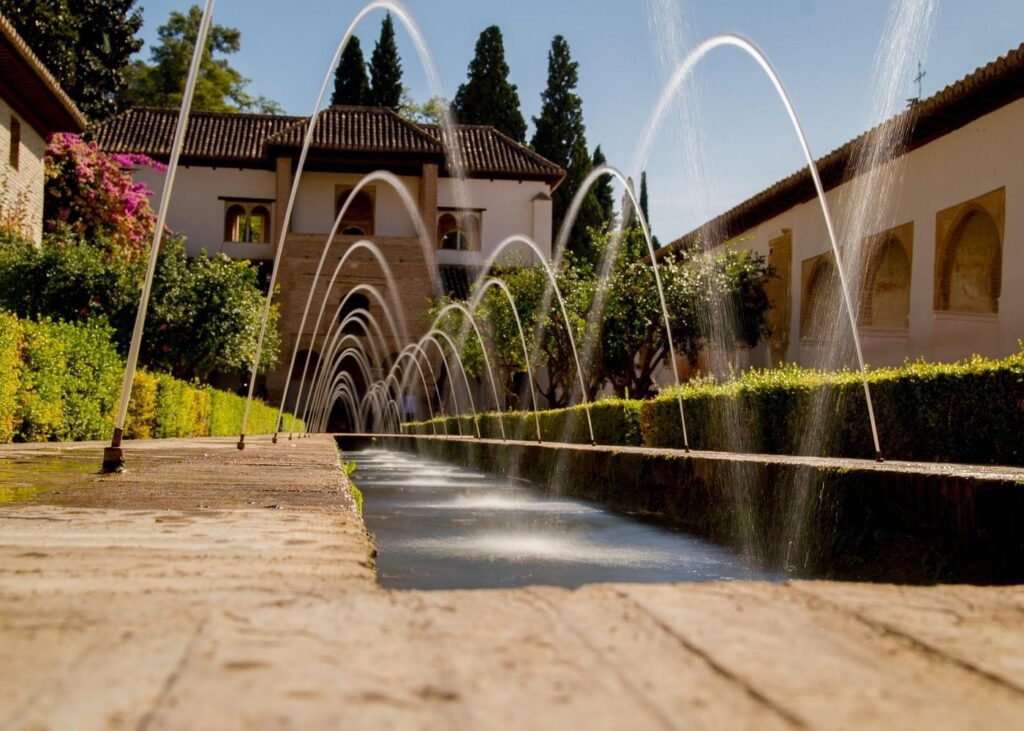
- Courtyards with water features and reflective pools
Water plays a central role in the design, symbolising purity and paradise, while also serving practical cooling and irrigation functions.
The decoration is highly symbolic, often combining religious, political, and poetic messages integrated into the architecture itself.
The Main Areas of the Alhambra
The Alhambra complex is divided into several distinct areas, each with its own function and historical significance.
The Alcazaba
The Alcazaba of the Alhambra is the oldest part of the complex and served as the military fortress.
Built primarily in the 13th century, it includes:
- Defensive walls and towers
- The Torre de la Vela, offering panoramic views of Granada
- Remains of soldiers’ quarters and internal streets
Its strategic position allowed control over the surrounding territory and the city below.
The Generalife
The Generalife was the summer residence of the Nasrid rulers.
It is famous for:
- Its beautiful gardens and water channels
- The Patio de la Acequia, with its long reflecting pool
- Carefully designed landscapes for relaxation and contemplation
The Generalife reflects the Islamic concept of paradise, with a strong emphasis on harmony between architecture, water, and nature.
The Nasrid Palaces
The Nasrid Palaces are the artistic and cultural heart of the Alhambra.
They include three main sections:
- Mexuar: administrative and judicial area
- Comares Palace: official residence, including the Hall of Ambassadors
- Palace of the Lions: private royal quarters, centred around the famous Lion Fountain
These palaces are renowned for their extraordinary decoration, refined proportions, and intricate symbolism. Every surface is covered with detailed ornamentation, combining geometry, calligraphy, and vegetal motifs.
The Partal
The Partal Palace area includes remains of earlier palace structures and gardens.
Its most recognisable feature is:
- A porticoed pavilion reflected in a long pool
This quieter area provides insight into earlier phases of the Alhambra’s development and offers scenic views of the surrounding landscape.
The Alhambra After the Christian Conquest
After 1492, the Alhambra underwent significant changes. While many Islamic elements were preserved, new constructions reflected Renaissance tastes.
The most notable addition is the Palace of Charles V, an imposing circular courtyard palace built within the complex. Although stylistically different, it represents the transition from medieval Islamic architecture to Renaissance Spain.